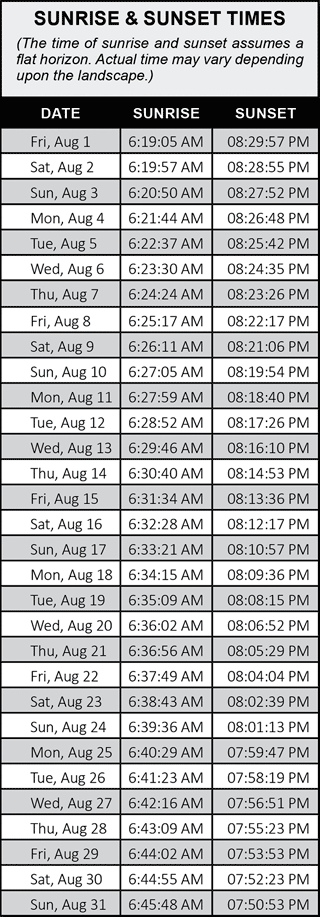
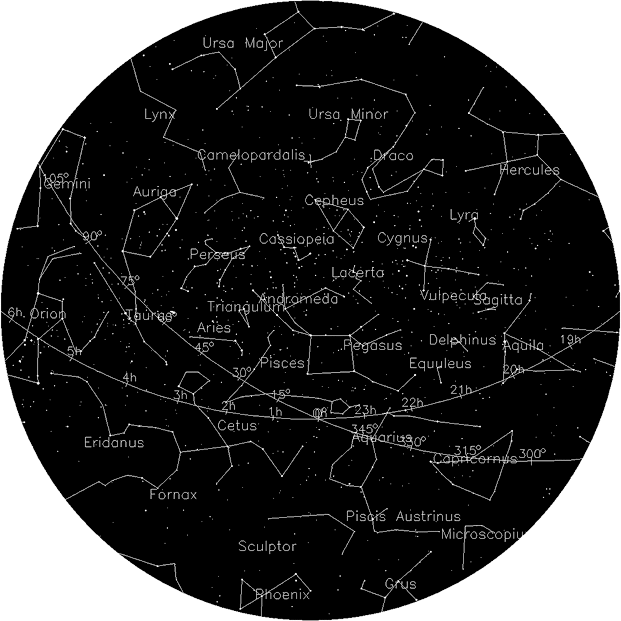
Here on Earth, we undergo a changing of seasons every three months. In the Northern Hemisphere, August 7 marks mid-point between the solstice and the equinox or between the longest day and when day and night are equal. But what about the rest of the Solar System? What does a sunny day on Mars look like? How long would a winter on Neptune be? Let’s take a tour of some other planets and ask ourselves what seasons might look like there.
Martian Autumn
Although Mars and Earth have nearly identical axial tilts, a year on Mars lasts 687 Earth days (nearly 2 Earth years) due to its average distance of 142 million miles from the Sun, making it late autumn on the red planet. This distance and a thin atmosphere make it less than perfect sweater weather. A recent weather report from Gale Crater boasted a high of 1˚ Fahrenheit the week of July 7, 2025.
Seven Years of Summer or 42 years of Darkness
Saturn has a 27-degree tilt, very similar to the 25-degree tilt of Mars and the 23-degree tilt of Earth. But that is where the similarities end. With a 29-year orbit, a single season on the ringed planet lasts seven years. But that is not as extreme as Neptune or Uranus. Even further away from the Sun, each season on Neptune lasts over 40 years. Uranus rolls on its side with an 84-year orbit and a tilt just 8° off its orbital plane. Its odd tilt may be from a lost moon or giant impacts. However it happened, each pole now gets 42 years of sunlight or darkness!
With half the astronomical summer ahead, August is a prime opportunity to catch the Milky Way with the new moon on August 23. Nighttime star gazing is a respite from the summer sun, and the sunset will be a little earlier until December.
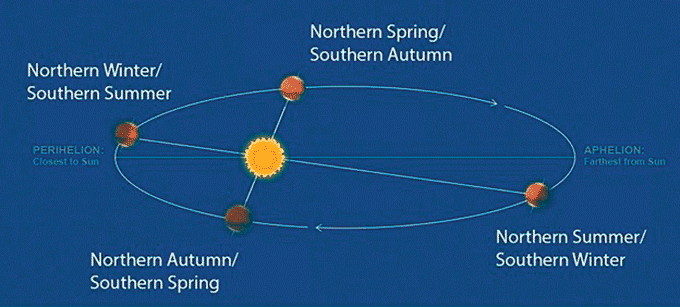 An artist’s rendition of Mars’ orbit around the Sun, and its seasons. Credit: NASA/JPL-Caltech
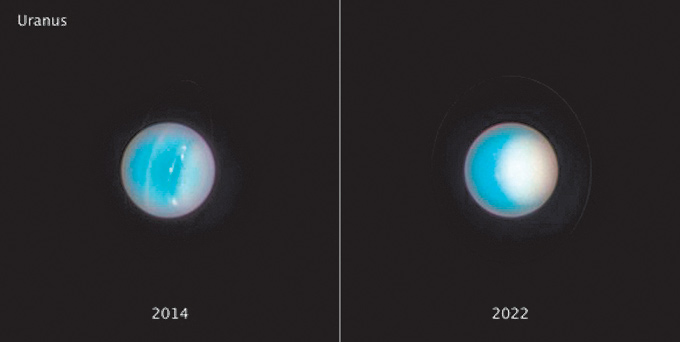 On Uranus, each pole gets 42 years of sunlight or darkness. Voyager 2 saw the south pole lit; now Hubble sees the north pole facing the Sun. Credit: NASA, ESA, STScI, Amy Simon (NASA-GSFC), Michael Wong (UC Berkeley); Image Processing: Joseph DePasquale (STScI)